AI Supply Chain Forecasting & Resilience
Reduce forecast errors and spot supply disruptions weeks early. Learn how AI demand forecasting builds supply chain resilience for Shopify stores.
Hylke Reitsma is co-founder of Forthsuite and a supply chain specialist with 8+ years of hands-on experience at Shell, Verisure, and Stryker. He holds an MSc in Supply Chain Management from the University of Groningen and writes practical guides to help e-commerce teams run leaner, faster supply chains. Selected by Replit as 1 of 20 founders for the inaugural Race to Revenue Cohort #1 (2026) and certified as a Replit Platform Builder.
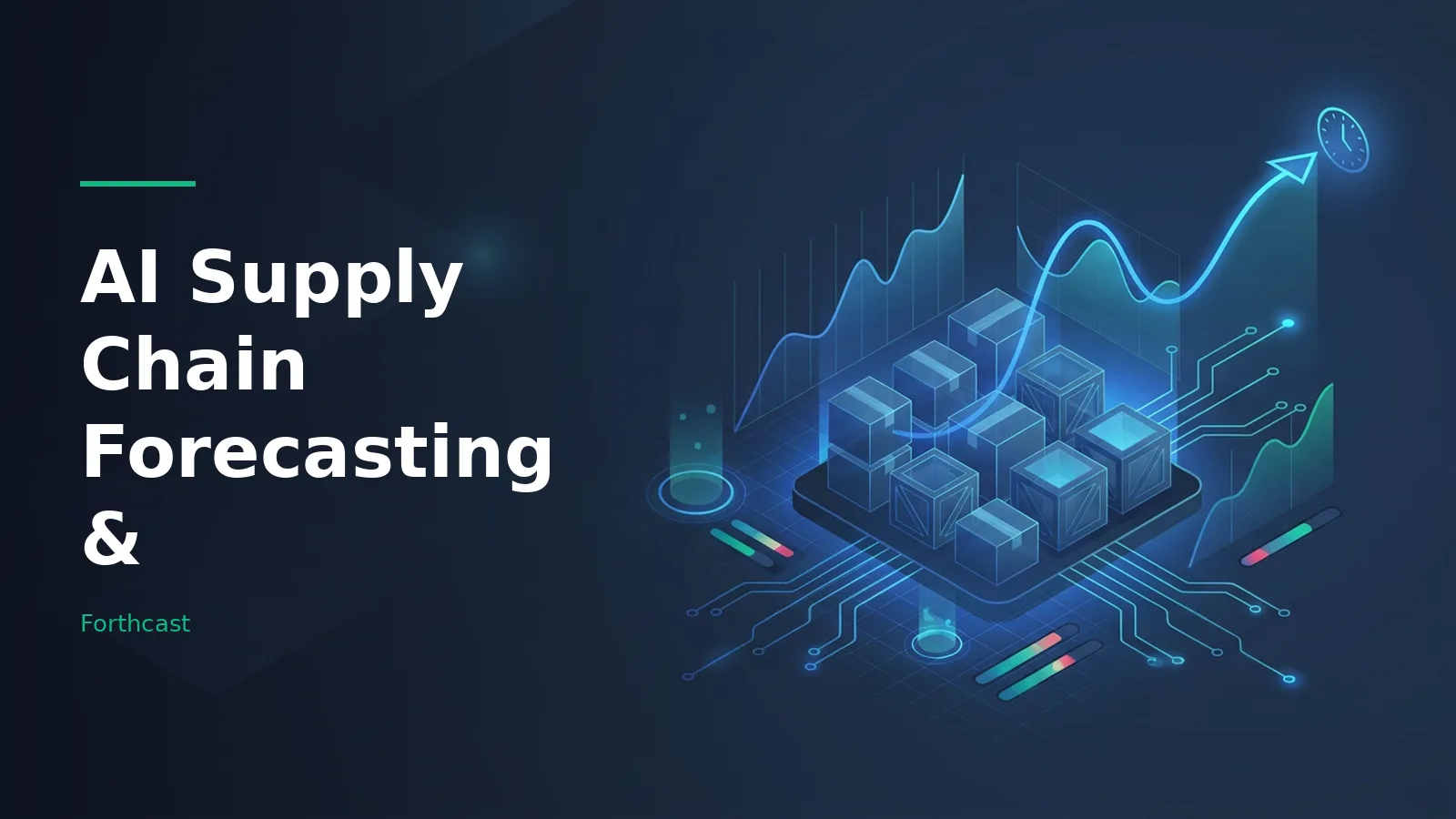
How AI Improves Supply Chain Forecasting & Resilience
TL;DR: Artificial intelligence (AI) continues to make waves across industries, and its impact on supply chain management is nothing short of transformative. Forthcast forecasts demand and reorder points for Shopify stores up to about 12 months ahead, surfaces stockout and lost-sales risk for review, and drafts purchase orders a merchant approves rather than placing them.
Last updated: July 2026
Artificial intelligence (AI) continues to make waves across industries, and its impact on supply chain management is nothing short of transformative. For e-commerce founders, retail executives, and supply chain professionals, the ability to predict demand, mitigate risks, and optimize logistics offers a competitive edge in an increasingly complex global landscape.
This article dives deep into how AI is reshaping supply chain operations, blending insights from industry leaders with practical applications. From predictive forecasting to supplier risk scoring and the implementation of AI agents, we explore how innovative technologies are driving operational efficiency and resilience.
The Role of AI in Demand Forecasting
Demand forecasting has always been a cornerstone of supply chain management, but traditional methods often fall short in today’s dynamic environment. AI-powered models are changing the game, enabling organizations to predict demand with greater accuracy and speed.
Advanced Algorithms Revolutionizing Forecasting
AI allows companies to integrate vast amounts of data - historical trends, seasonal patterns, market indexes, and even external factors like promotions or geopolitical signals - into forecasting systems. Jamie McIntyre Horstman, a director at Procter & Gamble, shared examples of their AI-powered tools:
- Long-Term Demand Sensing (LDS): This machine learning-driven system evaluates multiple models, selecting the one with the least error based on historical data. It accounts for seasonality, outliers, and unique trends, automating critical forecasting adjustments.
- Cannibalizer Model: This tool analyzes promotional sales events to predict how volume shifts between retailers (e.g., when Costco promotions reduce sales at Walmart or Target), ensuring forecasts reflect true incremental demand.
Additionally, short-term forecasting tools, like P&G's Intelligent Daily Forecaster, leverage real-time analytics to refine the next six weeks’ demand predictions daily.
The Human-AI Collaboration
While AI can analyze data and identify patterns at unprecedented speeds, human expertise remains essential. As Maria Roujo, a supply chain expert, emphasized, "AI provides probabilistic insights, but human judgment brings the necessary context to make informed decisions." By blending AI's computational power with human intuition, businesses can bridge the gap between raw data and actionable strategies.
sbb-itb-499c055
AI in Supplier Risk Scoring and Resilience
Supply chain resilience is critical, as disruptions can have far-reaching implications. AI-driven supplier risk models are proving indispensable for identifying early warning signs of instability - whether financial, operational, or geopolitical.
“on my side is a huge waste of time. I have zero value added for that. It's like an intern should be doing that.”
“I would need a tool basically a connector that just does a part of all this manual task for me.”
Early Warning Systems
AI can consolidate internal and external signals - supplier quality metrics, financial health indicators, geopolitical risks, and even unstructured data like news and social media posts. These insights feed into risk scoring models that act as "early warning radars", helping businesses anticipate disruptions.
Maria highlighted a key challenge: visibility diminishes as you move deeper into the supply chain. While companies might have strong oversight of tier-one suppliers, knowledge of tier-two and tier-three suppliers often drops below 10%. AI's ability to sift through vast datasets and provide probabilistic forecasts enables organizations to address vulnerabilities beyond their immediate supplier base.
Proactive Measures for Resilience
Shini Wasan Narin noted that AI fosters a shift from reactive to proactive management. For example, by monitoring supplier quality and delivery trends in real time, AI can flag potential risks before they escalate. This enables businesses to dual-source materials, build buffer stock, or renegotiate contracts proactively - saving time and money during crises.
Overcoming Data Challenges in AI-Driven Supply Chains
The effectiveness of AI depends heavily on the quality and availability of data. However, sharing data across supply chains introduces concerns about privacy, competitive advantage, and security.
To address these challenges, companies are adopting innovative solutions.
Balancing Transparency and Security
According to Maria, "The key is sharing the signal, not the raw data." Privacy-preserving techniques like federated learning allow organizations to share insights without compromising sensitive information. Other strategies include:
- Role-based access controls and encryption: Ensure that only authorized personnel access specific datasets.
- Standardized data schemas and APIs: Facilitate secure, interoperable data exchanges across platforms.
- Governance frameworks: Define what data can be shared and align all stakeholders on security protocols.
By fostering collaboration through industry consortia and public-private partnerships, businesses can collectively address bottlenecks while safeguarding intellectual property.
AI-Driven Logistics and Real-Time Optimization
Transportation and logistics are prime areas where AI can deliver immediate ROI by mitigating disruptions and reducing costs. From optimizing routes to predicting delays, AI enables supply chains to adapt in real time.
Real-Time Analytics in Action
Jamie shared how P&G leverages AI-enabled tools to improve transportation efficiencies. For example:
- Weather Adaptation: Systems automatically adjust routes or inventory levels based on weather forecasts. By shipping from alternative hubs or pre-stocking inventory, companies can avoid delays caused by storms or natural disasters.
- Cross-Border Challenges: AI tools monitor geopolitical developments, such as labor strikes or tariff changes. This allows companies to pre-emptively stock inventory or reroute shipments to less congested entry points.
Shini added that the greatest savings often come not from "cheapest freight", but from avoiding expedited costs and missed deliveries. AI’s ability to predict and dynamically reroute shipments ensures smoother operations and happier customers.
Measuring ROI: Turning AI Hype into Tangible Results
Despite the excitement surrounding AI, many organizations struggle to measure its ROI. To maximize the value of AI investments, businesses must clearly define problem statements and assess outcomes.
Defining Success Metrics
Jamie emphasized the importance of a before-and-after comparison. Whether it’s reducing unplanned downtime, increasing service levels, or cutting expedite costs, organizations need baseline metrics to quantify improvements. For example, avoiding stockouts or mitigating disruptions can translate into millions of dollars in savings.
Maria highlighted one area with strong ROI: robotics and computer vision. Automating production line tasks using AI can improve quality, boost throughput, and reduce labor costs, making a compelling case for investment.
Key Takeaways
- AI enables accurate demand forecasting through advanced algorithms, identifying trends and mitigating errors in real time.
- Supplier risk scoring models powered by AI provide early warnings based on financial, operational, and geopolitical signals.
- Collaboration across industries and the use of privacy-preserving technologies ensure secure data sharing and deeper supply chain visibility.
- Real-time analytics in logistics optimize routes, prevent delays, and minimize costs by dynamically responding to disruptions.
- Successful AI adoption requires clear problem definitions, baseline metrics, and strategic investments - avoid implementing AI for the sake of novelty.
Actionable Insights for E-Commerce and Retail Professionals
- Start Small, Scale Intelligently: Focus AI investments on high-impact areas like demand forecasting or logistics optimization.
- Invest in Data Governance: Build frameworks to securely share critical supply chain signals without exposing sensitive data.
- Leverage Predictive Analytics: Use AI tools to identify seasonality, trends, and risk factors, enabling proactive decision-making.
- Measure ROI: Define metrics like cost savings, service level improvements, or avoided disruptions to justify AI investments.
- Collaborate Cross-Functionally: Partner with suppliers, industry groups, and government bodies to build resilient supply chains.
AI offers unprecedented opportunities to transform supply chain management. By embracing data-driven strategies and fostering innovation, businesses can build resilient, agile supply chains that thrive in the face of uncertainty.
Source: "Can AI Predict and Prevent the Next Supply Chain Disruption?" - IIoT World, YouTube, Dec 12, 2026 - https://www.youtube.com/watch?v=3LM9fO9rTwU
Forecast demand and avoid stockouts — Forthcast for Shopify.
Frequently Asked Questions
How does AI improve supply chain forecasting accuracy?
AI improves forecasting accuracy by analyzing complex patterns across multiple data sources including sales history, seasonality, promotions, and external factors that traditional methods miss. Machine learning models automatically detect demand shifts and adjust predictions in real-time, reducing forecast error by 20-50% compared to manual methods.
Can AI forecasting make my Shopify supply chain more resilient?
Yes, AI enhances supply chain resilience by predicting disruptions, identifying alternative suppliers based on performance data, and automatically adjusting inventory buffers during high-uncertainty periods. It continuously monitors risk signals and provides early warnings about potential stockouts or supply delays.
What data does AI need to forecast my Shopify inventory effectively?
AI forecasting requires historical sales data by SKU, inventory levels, supplier lead times, and basic product information from your Shopify store. Enhanced accuracy comes from adding promotional calendars, traffic data, seasonality indicators, and external factors like market trends, though most AI tools can start with basic sales history.
How AI Improves Supply Chain Forecasting & Resilience?
Artificial intelligence (AI) continues to make waves across industries, and its impact on supply chain management is nothing short of transformative. Forthcast forecasts demand and reorder points for Shopify stores up to about 12 months ahead, surfaces stockout and lost-sales risk for review, and drafts purchase orders a merchant approves rather than placing them.
About the Author

Hylke Reitsma is co-founder of Forthsuite and a supply chain specialist with 8+ years of hands-on experience at Shell, Verisure, and Stryker. He holds an MSc in Supply Chain Management from the University of Groningen and writes practical guides to help e-commerce teams run leaner, faster supply chains. Selected by Replit as 1 of 20 founders for the inaugural Race to Revenue Cohort #1 (2026) and certified as a Replit Platform Builder.
LinkedIn