Your Judge.me reviews are a demand signal — here's how
A raw star rating can't tell you which products are genuinely exceptional — almost everything scores 4-plus. The Wilson Score can, and Forthcast uses it to…
Hylke Reitsma is co-founder of Forthsuite and a supply chain specialist with 8+ years of hands-on experience at Shell, Verisure, and Stryker. He holds an MSc in Supply Chain Management from the University of Groningen and writes practical guides to help e-commerce teams run leaner, faster supply chains. Selected by Replit as 1 of 20 founders for the inaugural Race to Revenue Cohort #1 (2026) and certified as a Replit Platform Builder.

Quick answer: Forthcast reads your Judge.me review data and uses the Wilson Score — the statistical method Netflix, Amazon, and Reddit use to rank items with unequal review counts — to find your genuine hero products and give them a bigger safety-stock buffer. It also watches review velocity: when a product's review rate jumps, Forthcast raises its buffer early, before the demand spike reaches your stock levels.
Last updated: July 2026
Your best-reviewed products convert better than anything else in your store. A product with 200 strong reviews is the one shoppers trust on sight — so it is also the one you can least afford to run out of. The trouble is that a raw star rating is a poor way to find those products, because almost everything you sell already looks good.
The rating paradox: when 4.6 stars stops being a signal
About 78% of reviewed products land at 4.0 stars or higher, and the distribution is J-shaped, not bell-shaped — most ratings pile up at the top, with a small tail of unhappy reviews (Hu, Pavlou & Zhang, “J-Shaped Distribution of Online Reviews,” 2009, replicated 2024). When almost every product reads as a 4.6, the average rating alone tells you very little about which items are genuinely exceptional — or which are one lucky five-star review away from looking that way.
Wilson Score: confidence, not just the average
The fix is a method Evan Miller documented in “How Not To Sort By Average Rating” (2009), now standard at Netflix, Amazon, and Reddit. Instead of asking “what is the average rating,” the Wilson Score asks: given this rating and this many reviews, what is the worst this product is likely to be, at 95% confidence? That lower bound is stable across very different sample sizes, so it does not get fooled by a tiny number of glowing reviews.
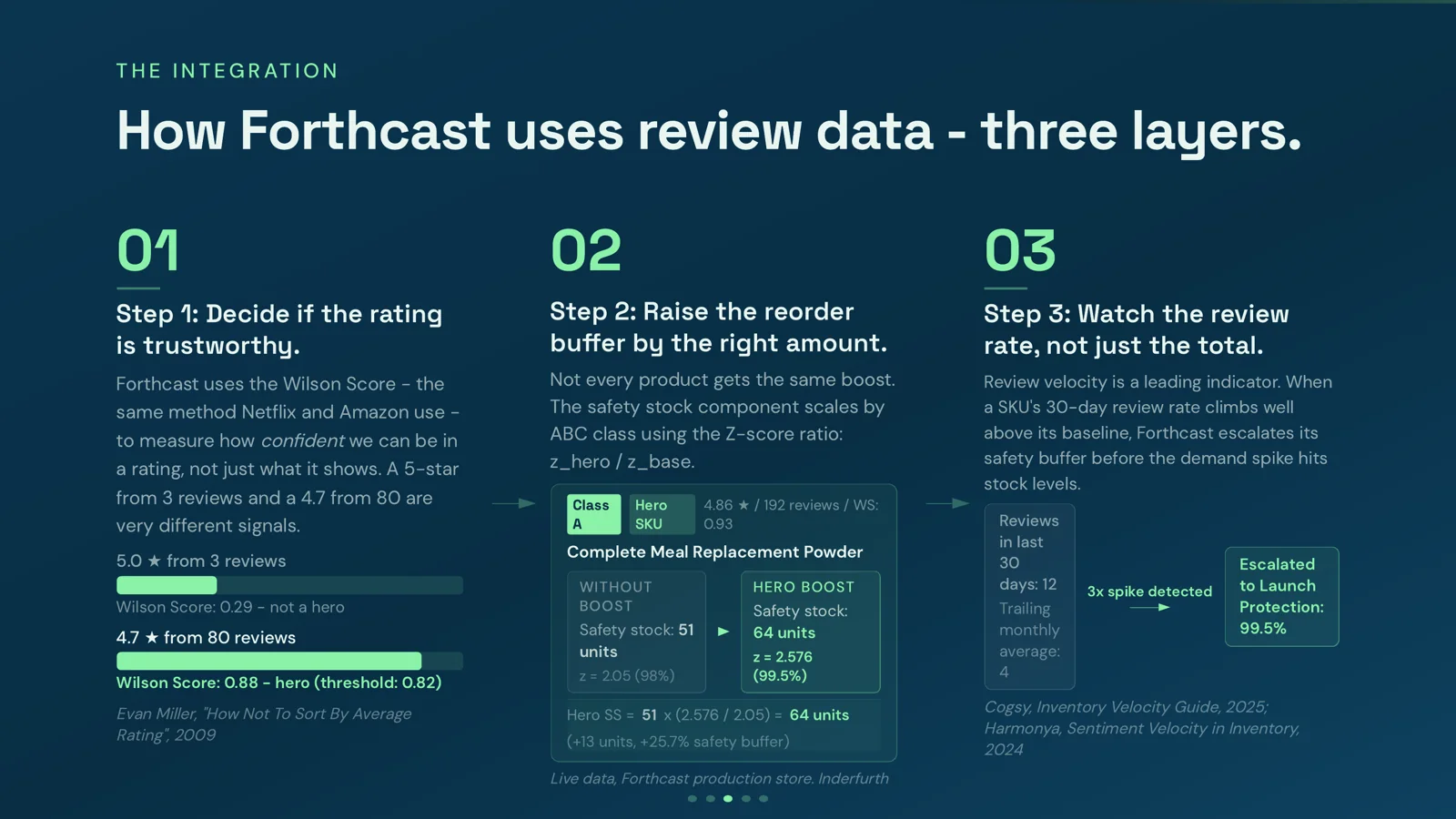
- A 5.0 from 3 reviews scores 0.29 — promising, but not proven. Normal buffer.
- A 4.7 from 80 reviews scores 0.88 — a genuine hero. Bigger buffer.
Forthcast computes a Wilson Score for every SKU nightly and treats anything above 0.82 as a hero product.
From confidence to safety stock
A hero score does not mean a blanket boost. Forthcast scales each hero SKU's safety-stock component by its ABC class, using the z-score ratio for the higher service level.
In a live example, a Class-A hero rated 4.86 from 192 reviews (Wilson Score 0.93) moved from a 51-unit safety stock (z = 2.05, 98% service level) to 64 units (z = 2.576, 99.5%) — a 25.7% larger buffer, sized to the product's real, statistically-backed demand rather than to a flat rule.
Review velocity is a leading indicator
The review total tells you what already happened. The review rate tells you what is about to.
When a SKU's 30-day review count climbs well above its baseline — say 12 reviews in the last 30 days against a trailing monthly average of 4 — that is usually demand moving before it fully shows up in your sales data. Forthcast escalates that product's buffer to the higher service level early, so you are protected before the spike reaches your stock. Merchants see a Launch chip on newly launched, review-accelerating SKUs, with the availability target raised accordingly.
The flywheel: why both systems get sharper
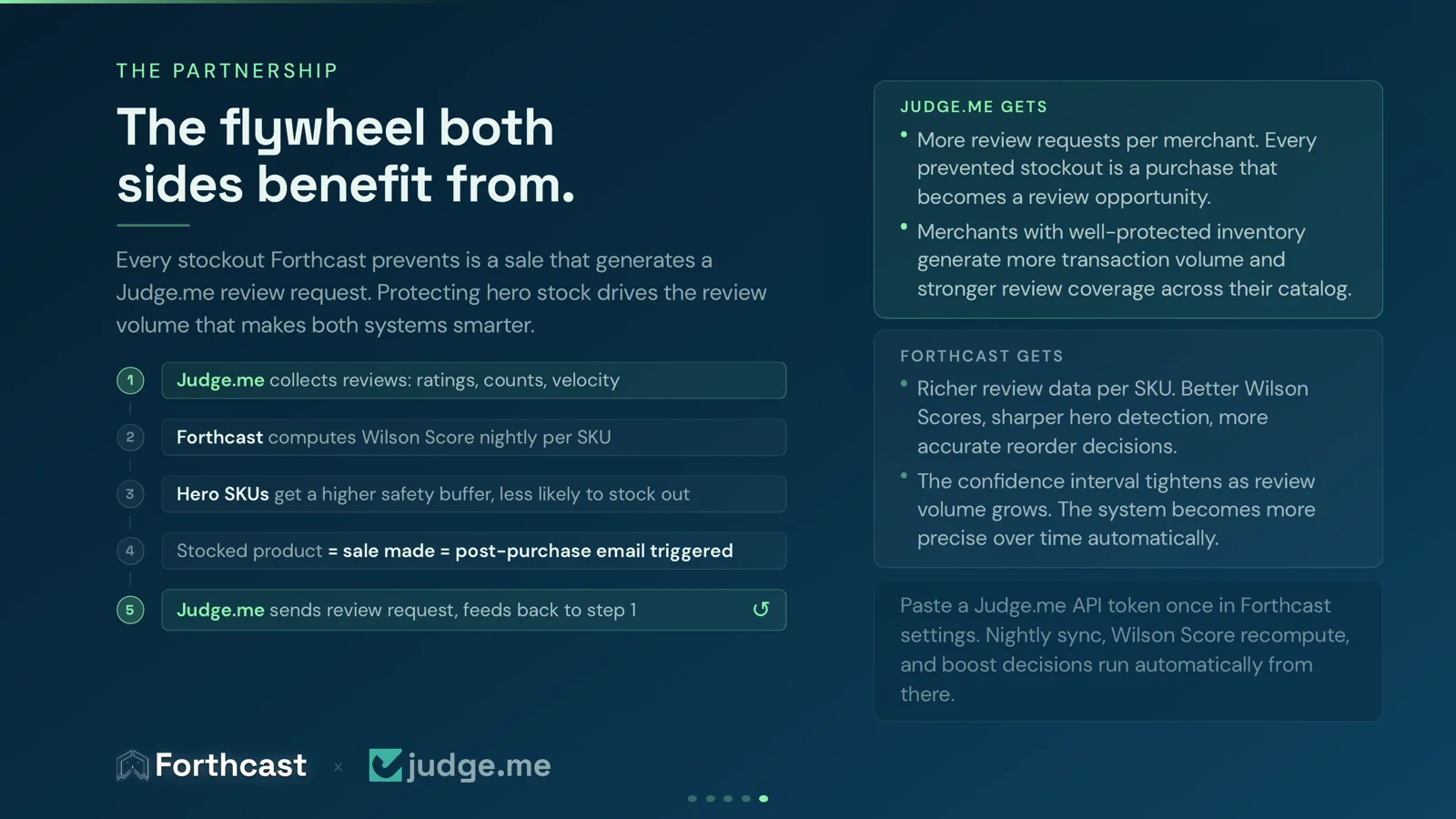
Every stockout Forthcast prevents is a sale, and every sale generates a Judge.me review request. Protecting hero stock drives the review volume that makes both systems more precise: Judge.me collects the reviews, Forthcast computes better Wilson Scores, hero SKUs stay in stock, the sale happens, and Judge.me sends the next request.
The confidence interval tightens as review volume grows — so the longer both run, the sharper the signal gets, automatically.
How to turn it on
If you already use Judge.me and Forthcast, paste your Judge.me API token once in Forthcast settings — the nightly sync, Wilson Score recompute, and buffer decisions run automatically from there, with nothing to configure per product. If you do not collect reviews yet, add Judge.me from the Shopify App Store and connect it to Forthcast — it is the most-installed reviews app on Shopify, and this is a two-way integration built together with the Judge.me team.
Frequently Asked Questions
Can Judge.me reviews improve inventory forecasting?
Yes. Forthcast reads Judge.me review data and uses the Wilson Score to identify genuine hero products, then gives them a larger safety-stock buffer. It also treats a spike in review velocity as an early demand signal and raises the buffer before the spike reaches your stock levels.
Why use the Wilson Score instead of the average star rating?
About 78% of reviewed products score 4.0 stars or higher, so the average rating barely separates good products from exceptional ones. The Wilson Score accounts for how many reviews back a rating, so a 4.7 from 80 reviews correctly outranks a 5.0 from 3 reviews.
About the Author

Hylke Reitsma is co-founder of Forthsuite and a supply chain specialist with 8+ years of hands-on experience at Shell, Verisure, and Stryker. He holds an MSc in Supply Chain Management from the University of Groningen and writes practical guides to help e-commerce teams run leaner, faster supply chains. Selected by Replit as 1 of 20 founders for the inaugural Race to Revenue Cohort #1 (2026) and certified as a Replit Platform Builder.
LinkedIn