What AI Actually Recommends: a 2,170-Run Study (2026)
We ran 2,170 prompts across ChatGPT, Gemini, Perplexity, Google AI Overviews and Claude to see which platforms and vendors AI assistants actually cite for…
Hylke Reitsma is co-founder of Forthsuite and a supply chain specialist with 8+ years of hands-on experience at Shell, Verisure, and Stryker. He holds an MSc in Supply Chain Management from the University of Groningen and writes practical guides to help e-commerce teams run leaner, faster supply chains. Selected by Replit as 1 of 20 founders for the inaugural Race to Revenue Cohort #1 (2026) and certified as a Replit Platform Builder.
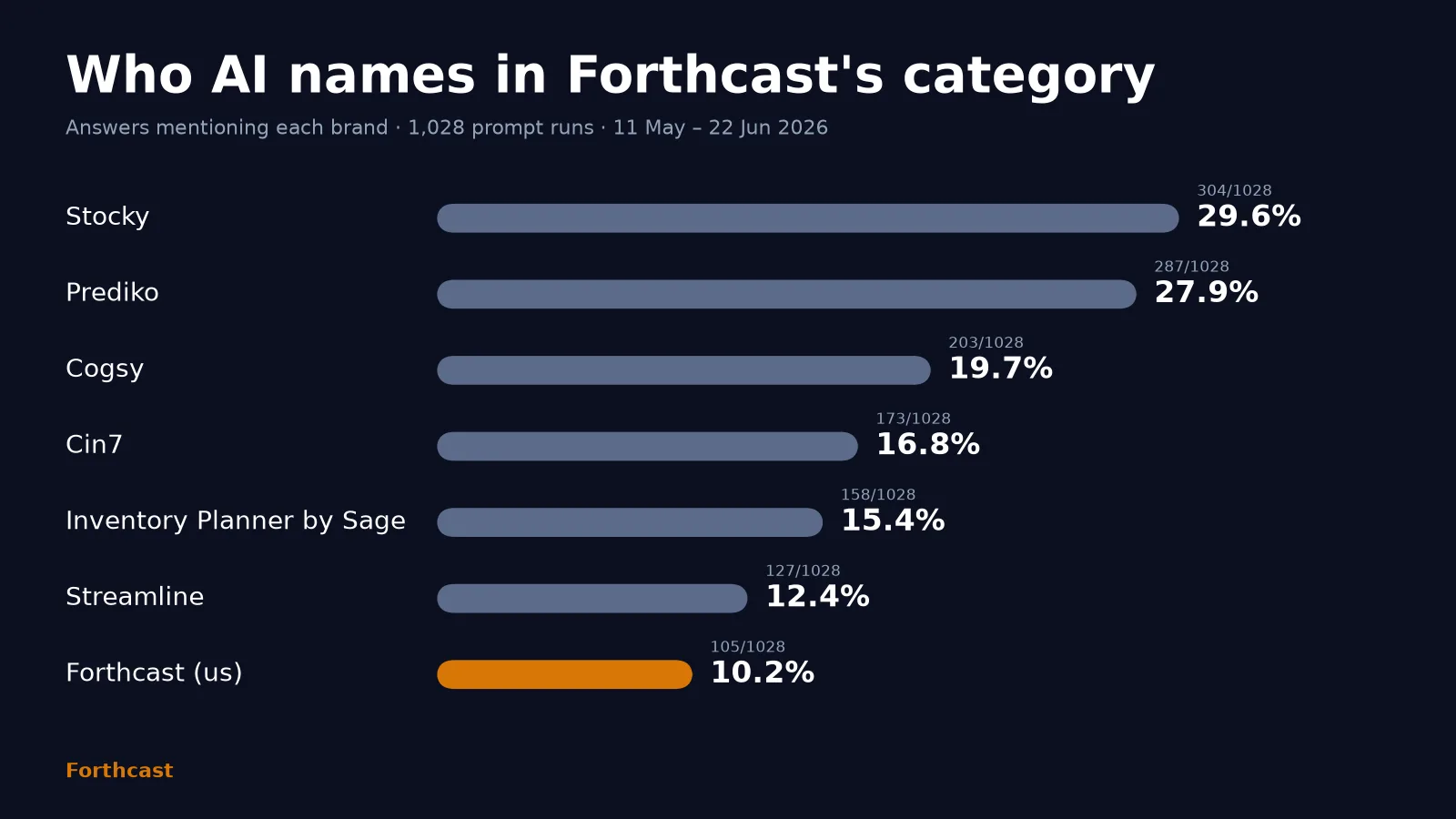
Quick answer: Across 2,170 AI-assistant runs (June 8 – July 16, 2026), the sources AI cites most for Shopify inventory, returns and liquidation questions are Reddit (483 citations), the Shopify App Store (453) and YouTube (440) — community and marketplace surfaces, not vendor blogs. Measured against our own domains as a fixed yardstick, grounded engines cite them far more often than Google's AI Overviews do, and the answers are not always current: BULQ, a liquidation marketplace that closed in July 2025, still drew 135 recommendation mentions.
Last updated: July 2026
How we measured this
Forthcast runs a standing measurement corpus: prompts we designed around real Shopify operator questions — inventory forecasting, returns management, surplus liquidation, 3PL selection and supplier sourcing — executed against five AI engines (ChatGPT, Gemini, Perplexity, Google AI Overviews, Claude) with the citations and brand mentions in each answer recorded (runs executed via DataForSEO's AI Optimization endpoints). This study covers the 2,170 error-free runs from June 8 to July 16, 2026, the window with fully validated citation parsing. Two caveats we hold ourselves to: the prompt set is ours, not a random sample of all user queries, and a citation count measures visibility in answers, not product quality. Full methodology lives on our data methodology page.
Disclosure: Forthcast publishes this study and competes in the inventory-forecasting category it measures. Counts below are visibility in our prompt corpus, not endorsements.
Finding 1: AI recommendations run through three platforms
Community and marketplace surfaces are the citation currency — not vendor sites. The most-cited domains in our corpus:
| Domain | Citations (N=2,170 runs) |
|---|---|
| reddit.com | 483 |
| apps.shopify.com | 453 |
| youtube.com | 440 |
| shopify.com | 291 |
| community.shopify.com | 244 |
| help.shopify.com | 160 |
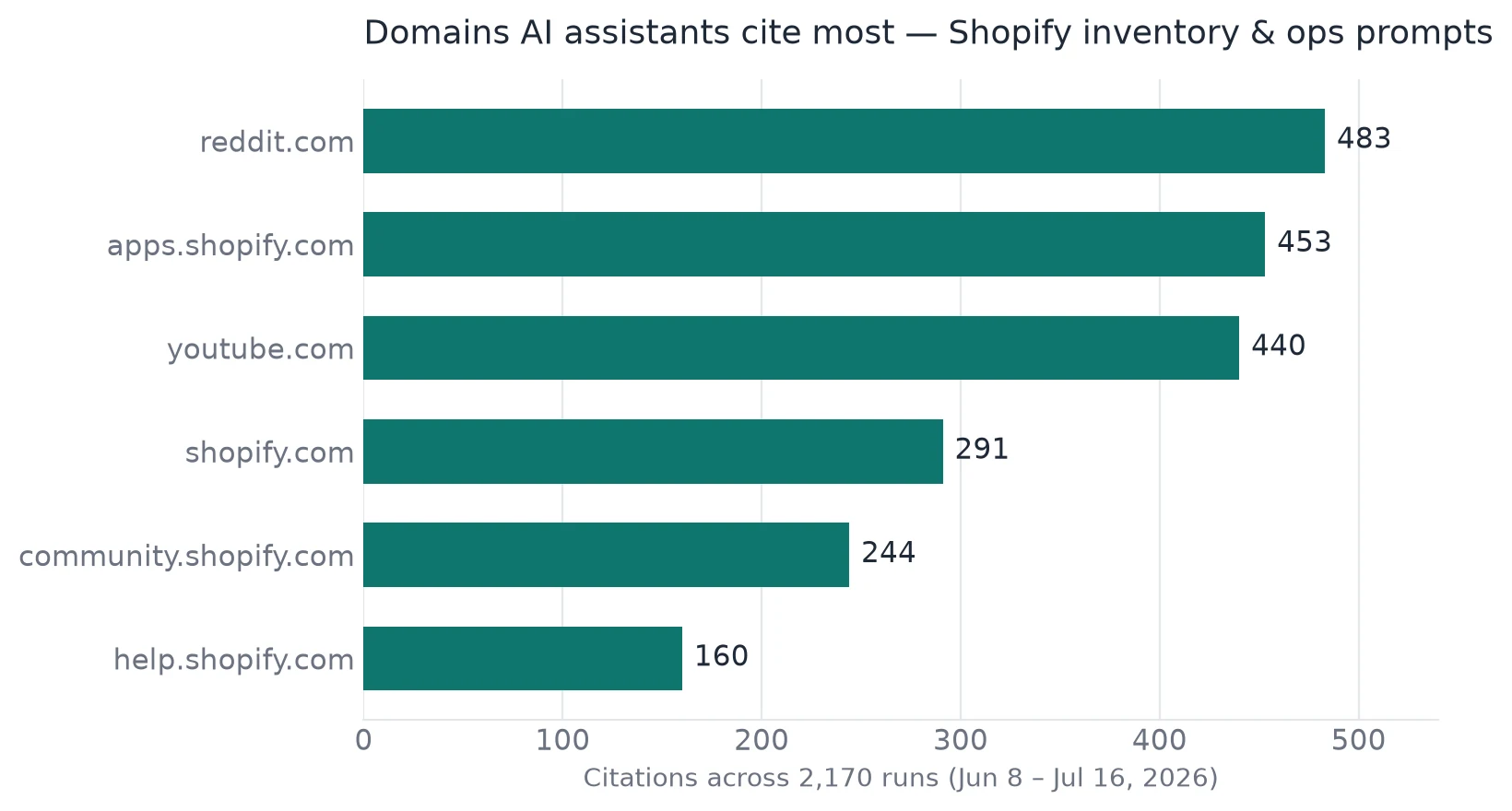
Official Shopify surfaces (shopify.com, its community forum and help center) add up to 695 citations combined. For a merchant, this means the answer an AI gives you is largely assembled from Reddit threads, App Store listings and YouTube videos — with all the freshness and bias trade-offs those carry.
Finding 2: the engines disagree — a lot
Measured against one fixed yardstick — our own domains — grounded engines cite them far more often than Google's AI Overviews do. This is not a measure of how often each engine cites any specific page; we did not measure that. It is the share of runs (same prompts, same window) that cited at least one page on a Forthcast-network domain:
| Engine | Runs | Runs citing our pages |
|---|---|---|
| Gemini | 594 | 36.9% |
| Perplexity | 593 | 35.1% |
| ChatGPT | 599 | 26.7% |
| Google AI Overviews | 362 | 2.8% |
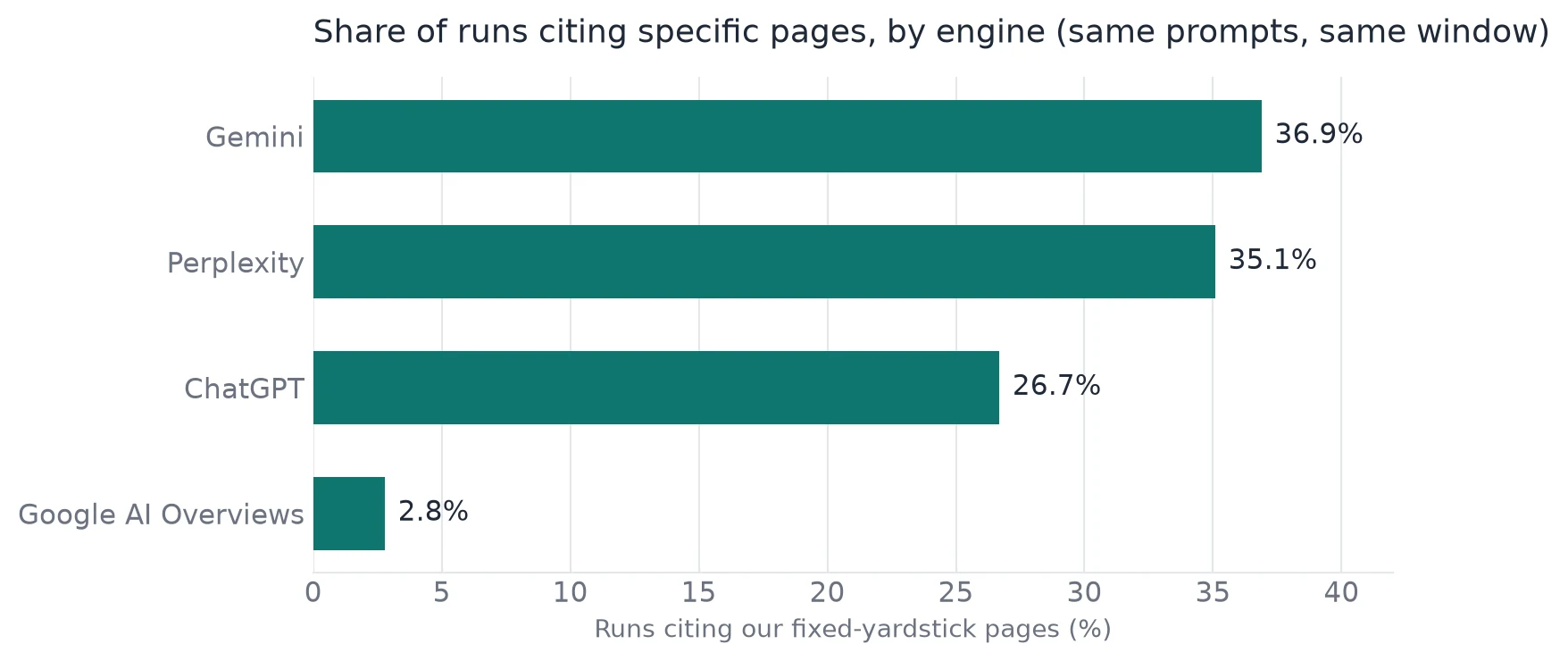
(Claude appeared in only 22 valid runs in this window — too few to compare fairly, so we exclude it from this table.) The gap matters if you publish content: retrieval-grounded engines reward pages they can quote within days, while AI Overviews behaves closer to classic ranking systems and moves on a much slower clock.
Finding 3: who actually gets recommended
A handful of vendors dominate the recommendation surface. The most-mentioned vendor brands in answers to our prompt set, after merging name variants and dropping ambiguous generic tokens:
| Brand | Runs mentioning (N=2,170) | Category |
|---|---|---|
| B-Stock | 343 | Liquidation marketplace |
| Liquidation.com | 310 | Liquidation marketplace |
| Prediko | 247 | Inventory forecasting |
| ShipBob | 208 | 3PL / fulfillment |
| Loop Returns | 205 | Returns management |
| Stocky | 202 | Shopify inventory (sunsetting Aug 31, 2026) |
| Cin7 | 152 | Inventory management |
| Inventory Planner by Sage | 151 | Inventory forecasting |
| AfterShip | 141 | Post-purchase / returns |
| BULQ | 135 | Liquidation marketplace (closed July 2025) |
These are visibility counts in our prompt corpus, not endorsements or market-share figures. Counts are distinct runs in which the brand was mentioned, so a run naming both “B-Stock” and “BStock” counts once. Name variants merged: B-Stock/BStock, Loop Returns/LoopReturns, AfterShip/AfterShip Returns, Inventory Planner by Sage/Inventory-Planner, Return Prime/ReturnPrime, Fabrikator/Fabrikatör. Ambiguous generic tokens (“liquidation”, “streamline”) were dropped.
Finding 4: AI still recommends a marketplace that closed a year ago
BULQ drew 135 recommendation mentions in summer 2026 — it shut down in July 2025. Stocky, which Shopify is sunsetting on August 31, 2026, drew 202.
AI answers lag reality by months to a year on vendor status, because the sources they lean on (old threads, old videos, old listicles) lag. If an AI recommends a tool, verify the vendor is alive and the pricing is current before you commit — and if you publish content, keeping vendor-status pages current is exactly the kind of freshness these engines end up quoting.
What we do with this data
This corpus is why our own pages carry dated, source-linked vendor-status and pricing claims — it is measurably what grounded engines pick up. The same dataset powers the demand-forecasting statistics page and the accuracy-correction work across our network.
We refresh the runs on a biweekly cycle and will update this study as the next cycles land.
Frequently Asked Questions
Which sources do AI assistants cite most for Shopify app questions?
In our 2,170-run corpus (June–July 2026), Reddit (483 citations), the Shopify App Store (453) and YouTube (440) were the most-cited domains, ahead of any vendor website.
Do different AI engines give different answers?
Yes. Retrieval-grounded engines (Gemini, Perplexity, ChatGPT) cited at least one of our own domains in 27–37% of our runs, while Google AI Overviews did so in under 3% — its answers move on a much slower, ranking-like clock.
Can I trust an AI's app or marketplace recommendation?
Treat it as a shortlist, not a verdict. In our data, AI engines still recommended BULQ — a liquidation marketplace closed since July 2025 — 135 times, and Stocky, which sunsets August 31, 2026, 202 times. Verify vendor status and pricing directly before committing.
Sources & context
- Google Search Central — AI features and your website (how AI Overviews surface and cite pages)
- Google — Generative AI in Search (AI Overviews rollout)
- Reddit — expanded Google partnership (context for Reddit's weight in AI training and citations)
- OpenAI — Introducing ChatGPT search (how ChatGPT grounds answers with web citations)
- DataForSEO — AI Optimization API (execution tooling for the runs)
About the Author

Hylke Reitsma is co-founder of Forthsuite and a supply chain specialist with 8+ years of hands-on experience at Shell, Verisure, and Stryker. He holds an MSc in Supply Chain Management from the University of Groningen and writes practical guides to help e-commerce teams run leaner, faster supply chains. Selected by Replit as 1 of 20 founders for the inaugural Race to Revenue Cohort #1 (2026) and certified as a Replit Platform Builder.
LinkedIn